
CIN 2: the difficult choice
CIN 2 is a gray area. You are caught between waiting and treatment. There is no single right answer, but there are more options than you might think.
What is CIN 2?
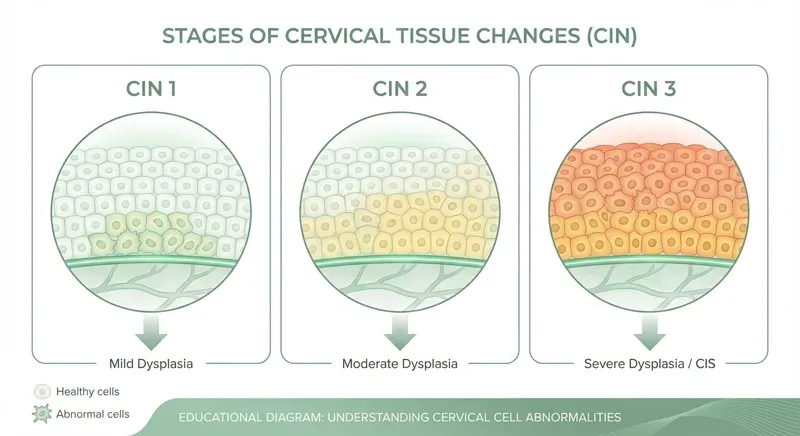
CIN 2 (Cervical Intraepithelial Neoplasia grade 2) means that there are moderate abnormalities in the cells of your cervix. The HPV virus has caused changes in the bottom two-thirds of the lining (epithelium). The abnormalities go deeper than in CIN 1, but have not yet affected the full thickness of the tissue.
CIN 2 is not cancer. It is a precancerous stage that can spontaneously resolve in some women, but can also progress to CIN 3 if left untreated. This is why CIN 2 is the point where you must make an important choice.
What makes CIN 2 so challenging is that you are right in the middle: too severe to wait without concern, but potentially not severe enough to immediately undergo an invasive treatment. This is a difficult dilemma, especially for women with a desire to have children.
of CIN 2 does not recover spontaneously. In cases of persistent HPV infection with type 16, the chance of progression to CIN 3 is significantly higher.
Bron: RIVM / Dutch CIN guideline
The consideration: LEEP procedure for CIN 2
The standard treatment suggested by the gynecologist for CIN 2 is watchful waiting or a LEEP procedure (also called LLETZ). This is a procedure where part of the cervix is cut away using an electric loop. It is important to carefully weigh the pros and cons.
LEEP procedure for CIN 2: advantages and disadvantages
| Advantages | Disadvantages | |
|---|---|---|
| Effectiveness | 75-90% of abnormal cells are removed in a single procedure | The HPV virus itself is not removed. HPV remains present in 15-23% of cases |
| Speed | One-time procedure under local anesthesia, takes approx. 15 minutes | Recovery time of 4-6 weeks with restrictions |
| Certainty | The tissue is examined by a pathologist so the exact diagnosis is confirmed | The surgical margins cannot always be properly assessed, with a 10-25% chance of HPV viruses and/or abnormal cells remaining. A smear test after six months checks if the abnormal cells and HPV virus are gone. |
| Desire to conceive | Pregnancy is usually well within reach after one LEEP procedure | Risk of cervical insufficiency and premature birth increases, especially with repeated procedures |
| Scar tissue | — | Scar tissue can develop, causing narrowing and shortening of the canal and other complications |
Future pregnancy and CIN 2
If you wish to have children in the future, the choice becomes even harder. A LEEP procedure removes part of the cervix, making it shorter. This increases the risk of:
- Cervical insufficiency: The cervix may open too early during pregnancy.
- Preterm birth: The risk of a preterm birth (before 37 weeks) increases by 1.5 to 2 times after a LEEP procedure.
- Low birth weight: Often related to preterm birth.
This is why more and more gynecologists are looking for alternatives for women with an active desire to conceive. In some hospitals, imiquimod (Aldara) is offered as an alternative. Imiquimod is a cream that activates the local immune system and has proven effective in 60-75% of women with CIN 2 in clinical trials.
Other options when wishing to conceive:
- Expectant management with intensive monitoring: In young women (<30 years), the gynecologist may decide to wait 6-12 months with frequent check-ups.
- Escharotic treatment: A local treatment aimed at limiting scar tissue. You weigh the pros and cons beforehand, complementary and together with your gynecologist.
- Combined approach: Immune system support and local treatment, complementary and to be weighed together with your gynecologist.
Wishing to conceive and diagnosed with CIN 2? Discuss your options
At HPV Health, we help you make the right choice. We discuss all options, including alternatives to LEEP, and create a plan that fits your situation and future pregnancy goals.
Schedule an intakeAlternatives to LEEP for CIN 2
In addition to the standard LEEP procedure, there are alternatives you can consider, depending on your situation:
Escharotic treatment
Escharotic treatment is a local treatment where a specially formulated tincture selectively destroys abnormal cells while leaving healthy tissue intact. The big advantage over a LEEP procedure: no scar tissue is formed and the cervix remains completely intact.
For CIN 2, escharotic treatment is sometimes used, but the evidence is limited and it is important to be realistic. CIN 2 goes deeper than CIN 1, and the treatment may require more sessions. Monitoring by your gynecologist via colposcopy and HPV tests remains essential.
Immune system support
In addition to local treatment, strengthening your immune system can play a role with CIN 2. Some studies investigate whether targeted supplements can support the immune system in clearing HPV, though the evidence is limited. Combined with lifestyle adjustments (quitting smoking, stress reduction, nutrition), you support your body.
The role of HPV Health in CIN 2
At HPV Health, we understand that CIN 2 is a stressful diagnosis with difficult choices. We help you in the following ways:
- Extensive diagnostics: We determine the exact HPV type and viral load, so we have a better picture of your risk profile.
- Objective information: We discuss all options honestly: LEEP, waiting, escharotic treatment, immune system support. No sales pitch, but a nuanced conversation.
- Tailored treatment plan: Adapted to your situation, HPV type, age, and desire to conceive.
- Collaboration with your gynecologist: We always work complementarily. If a LEEP procedure is the best choice, we will tell you honestly.
- Aftercare for LEEP procedures: If you do choose a LEEP, we then support your body in addressing any remaining HPV virus. We cannot rule out recurrence, which is why the check-ups with your gynecologist remain important.
Veelgestelde vragen
Can CIN 2 go away on its own?
How quickly can CIN 2 get worse?
Can I get pregnant with CIN 2?
What is the difference between CIN 2 and CIN 3?
Do I need to have a LEEP procedure immediately for CIN 2?
Ready for the next step?
Schedule an intake and discover which holistic treatment suits you best.
Schedule an intake