
HPV test: what additional information is possible?
The Dutch standard test is reliable and tells you whether you have HPV. It does not, however, indicate which type, how much virus, or whether it is changing. There is a complementary test that can provide this extra information.
What the Dutch standard test does and does not show
There are two important HPV tests used by gynecologists and general practitioners (GPs). In the Netherlands, it is primarily the Aptima test. This test gives a simple answer: positive or negative. The test determines a mix of high-risk HPV types simultaneously, without specifying which type you have.
Dutch test vs. Belgian test
HPV Test Comparison
| Feature | Dutch test (Aptima) | Belgian test (RIATOL qPCR) |
|---|---|---|
| Result | Positive or negative | Quantitative viral DNA per type |
| Genotyping | None (mix of types) | 18 individual HPV types |
| Viral load | Not measured | Exact amount of virus |
| Genes detected | mRNA | E6/E7 oncogenes per type |
| Monitoring possible | No | Yes, viral load progression |
| Experience | Since NL screening program | 15+ years routinely in Belgium |
| Technology | mRNA detection | Multiplex PCR |
The Belgian RIATOL qPCR test has been used routinely in Belgium for more than 15 years. It is a multiplex PCR test that measures quantitative viral DNA and individually detects the E6/E7 oncogenes of 18 different HPV types. PCR technology is very specific and sensitive: it also picks up low concentrations of the virus.
Same smear test, two completely different results
To make the difference concrete: the same smear test can lead to completely different results in the Netherlands and Belgium.
Case study: same smear test, two laboratories
| Dutch lab | Belgian lab | |
|---|---|---|
| Smear test | PAP 1 | PAP 1 |
| HPV result | HPV negative | HPV 59 present in <1.0 in the cells |
| Consequence | Return to 5-yearly screening program | Monitoring and follow-up |
In this case, HPV 59 was not picked up by the Dutch test, while the Belgian lab did detect the virus. The Dutch test is reliable, but at low concentrations a result can differ. Based on the Dutch result, this woman would, under the screening program, be tested again after 5 years. A complementary quantitative test, alongside and not instead of the regular test, can help follow the progression of the viral load in the meantime.
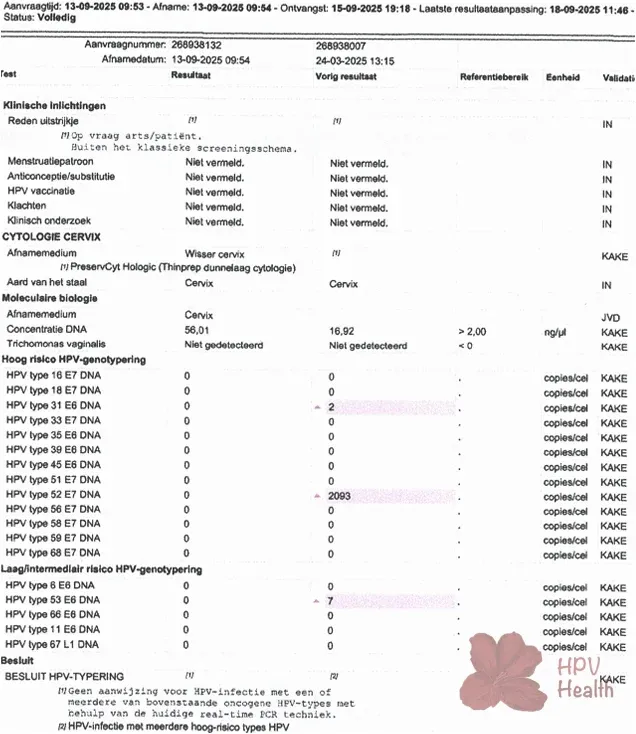
Another example of a test result. This woman, over 60 years old, had CIN 1 and was HPV-positive. We see that there are 2 high-risk viruses and 1 low-risk virus. In this individual case, the viruses were no longer detectable after the treatments (escharotic and LLL Low Level Laser). This is the course in one person and not proof of efficacy; the immune system often clears HPV on its own too. Regular check-ups remain necessary.
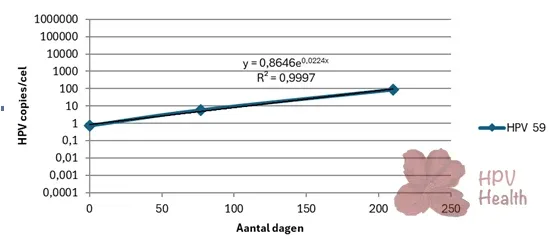
of the viral load precedes the development of CIN 3+. By monitoring the viral load, you can identify a worsening sooner.
Why genotyping and viral load matter
The quantitative HPV test offers two crucial advantages over the standard test:
1. Genotyping: which HPV type do you have?
Not every HPV type is equally dangerous. HPV 16 and 18 are the most aggressive types and are responsible for the majority of cervical cancer cases. Knowing which type you have helps determine the risk and the urgency of treatment.
2. Viral load: how much virus is there?
The amount of virus in your cells is an important indicator. A steady increase in viral load precedes the development of serious abnormalities (CIN 3+). By regularly measuring the viral load, you can follow the progression and intervene in time.
The regular test and the screening program are reliable. If HPV is not detected at low concentrations while it is present, you will be invited again after 5 years according to the regular schedule. A complementary quantitative test can give extra information about the progression in that period, as an addition to and not a replacement for the regular test.
The HPV test via HPV Health
At HPV Health, we work with the quantitative PCR test. This gives us and you the information needed to create a well-informed treatment plan:
- Exactly which HPV type you have (out of 18 types)
- How much virus is present (viral load)
- The possibility to monitor progression with follow-up measurements
Based on these results, we create an individual treatment plan focused on supporting your immune system, which plays a role in how your body deals with HPV. This is a best-effort approach, not a guarantee of results, and it does not replace regular check-ups.
Do you want to know which HPV type you have and how much virus is present?
The quantitative HPV test gives you the information you need. More insight alongside population screening, with concrete data that we can use together.
Request the HPV testVeelgestelde vragen
Are the tests reliable?
Can I have the quantitative test done through my general practitioner (GP)?
How often should I repeat the HPV test?
What if my Dutch test is negative but I still have symptoms?
Are the costs of the test reimbursed?
Ready for the next step?
Schedule an intake and discover which holistic treatment suits you best.
Schedule an intake